Sound on: using acoustic enrichment to boost coral larval settlement

  • United States, US Virgin Islands
  • Dominica
  • United Kingdom, Cayman Islands
  • Coral restoration

Credits: WHOI

Facing a challenge

Successful settlement of coral larvae is key to the survival and recovery of coral populations. Unfortunately, many coral reefs currently struggle to replenish themselves naturally due to reduced larval settlement, a consequence of declining coral populations, lower availability of coral larvae and the absence of natural settlement-promoting cues. Coral larvae can respond to environmental cues, such as sound, to locate suitable habitats for settlement. However, degraded reefs lack the rich soundscapes typical of healthy coral reefs that attract coral larvae. With no cues to encourage larvae to settle on degraded reefs, natural larval settlement rates are likely to remain low.
CHALLENGE_credits WHOI

Credits: WHOI

With an innovative solution

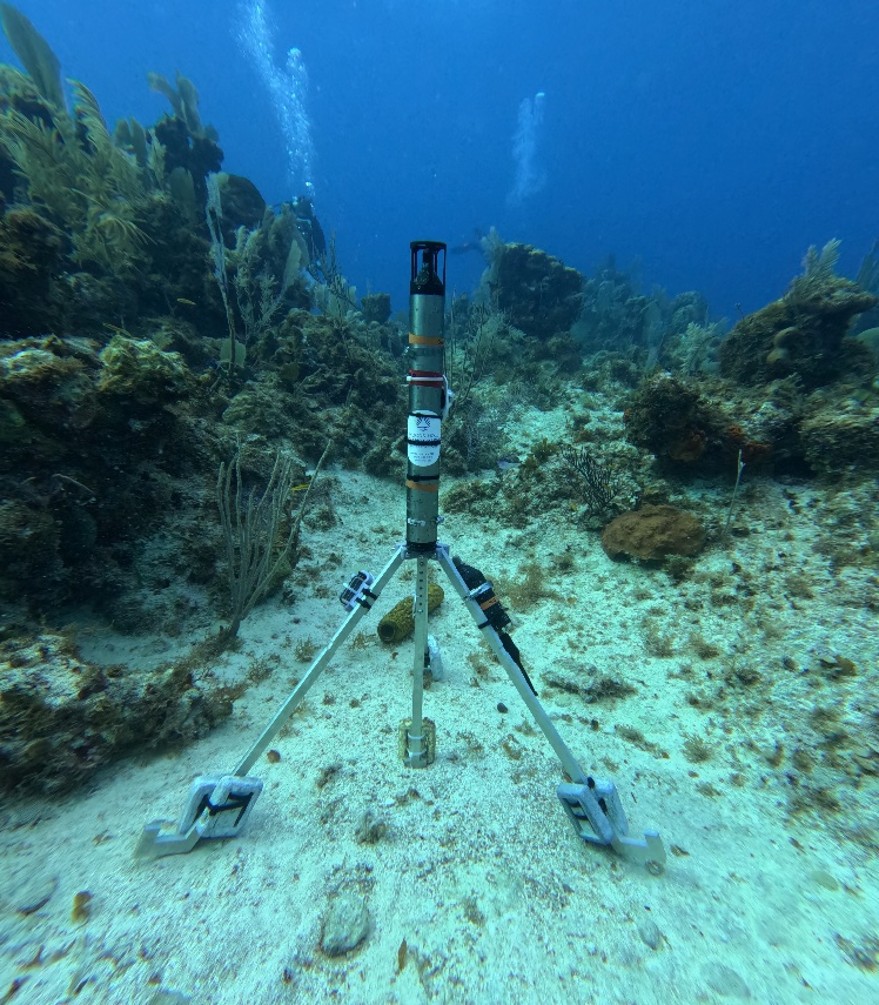
The team will use a Reef Acoustic Playback System (RAPS) to play back healthy reef soundscapes onto degraded reefs. This acoustic enrichment method is expected to attract coral larvae to these areas and create positive feedback loops that support the restoration of the reef ecosystem. To achieve this in the US Virgin Islands, Dominica, and the Cayman Islands, the team will:
  • test how 3-6 coral reef-building species respond to various acoustic enrichment treatments, and study their biology (including fertilization and growth)
  • measure settlement success under different acoustic conditions
  • deploy RAPS in diverse locations across the US Virgin Islands, Dominica, and the Cayman Islands
  • monitor temperature, salinity, and hydrodynamic currents around the Cayman Islands and on the west side of Dominica because they may affect the efficacy of acoustic enrichment
  • test different sites to evaluate their effectiveness in promoting coral settlement.
  • host training workshops to educate local stakeholders on the use of RAPS
  • leave RAPS systems with local users to gather long-term data and refine and improve the system for broader application in coral restoration
SOLUTION_credits WHOI

Credits: WHOI

What impact looks like

  • A robust and user-friendly tool to boost coral restoration through promoting larval settlement
  • Increased capacity-building of local stakeholders – (scientists, divers, local managers, eco-tourism operators)
  • Improved understanding of how different coral species respond to sound cues, contributing to more effective coral restoration strategies
  • Increased coral larval settlement in degraded reef areas, supporting the recovery and sustainability of coral ecosystems

Project Title

Increasing the capacity of acoustic enrichment applications for larval settlement and restoration

Lead

Dr. Aran Mooney

Co-leads

Dr. Gordon Zhang (M), Dr. J. Jacob Levenson (M), Mr. Simon Walsh (M), Dr. Gretchen Goodbody-Gringley

Countries involved

Dominica, Cayman Islands, and USA

Takes place

Dominica, Cayman Islands, and US Virgin Islands

Supporting institutions

Woods Hole Oceanographic Institution (USA), Oceans Forward (Dominica), Central Caribbean Marine Institute (Cayman Islands)

Total budget

USD 1,499,936

Duration

October 2024 – September 2027

    • Tested Reef Acoustic Enrichment System (RAPS) on multiple coral species
    • Developed hydrodynamic models for sound propagation in restoration sites
    • Trained NOAA, The Nature Conservancy and aquarium staff in RAPS deployment and use
  1. 2026
  2. 2027

Share this project

Email
X
Facebook
LinkedIn
WhatsApp